Teams gather, someone pulls out a checklist, reads a few lines about hard hats, and calls it a day. The crew nods, signs in, and returns to work. On paper, safety was addressed. In reality? The message didn’t stick.
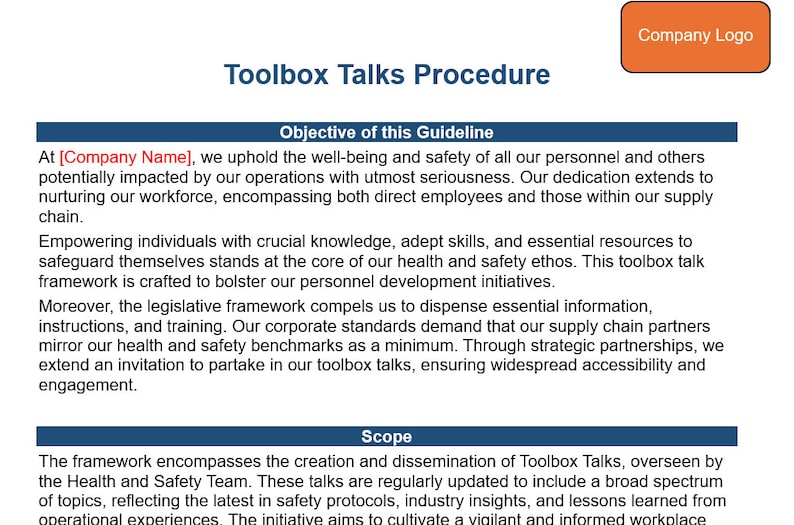
This is the flaw in ad hoc safety talks: lack of structure, relevance, and engagement. A well-designed toolbox talk topics template solves this by standardizing delivery, anchoring discussions in real job-site risks, and making participation routine — not ritual.
This isn’t about checking a compliance box. It’s about creating a culture where safety conversations are meaningful, memorable, and tied directly to the work being done right now. Whether you're in construction, manufacturing, utilities, or logistics, a structured template turns vague safety reminders into actionable insights.
Let’s break down exactly how to build, use, and adapt a toolbox talk topics template that actually works.
What Is a Toolbox Talk Topics Template?
A toolbox talk topics template is a standardized format used to prepare and deliver short, focused safety discussions — typically 5 to 15 minutes long — held before or during work shifts. Unlike broad safety training, these talks target specific, timely hazards present at the job site.
The template serves as a reusable framework that includes: - Topic title - Objective or purpose - Key discussion points - Real-world examples - Employee engagement questions - Sign-off sheet
Its value lies in consistency. With a template, facilitators don’t start from scratch every time. Instead, they plug in the relevant hazard, adjust for site conditions, and lead a focused conversation.
Core Components of an Effective Template
A strong template isn’t just a form to fill out — it’s a tool to drive behavior change. Here are the non-negotiable elements:
1. Topic Title & Date Clear and specific. Not “General Safety,” but “Proper Ladder Use on Uneven Ground – April 2.”
2. Objective Statement One sentence explaining the goal: “Ensure all team members inspect and set up ladders correctly to prevent falls.”
3. Hazard Description Describe the risk in plain language. Include data if possible: “Falls from ladders account for 21% of construction injuries (OSHA).”
4. Best Practices Actionable steps workers should take. Use bullet points:
- Always inspect ladder for cracks or loose rungs
- Maintain 3-point contact when climbing
- Set on level ground or use stabilizers
5. Real Job-Site Example Tell a brief story — real or hypothetical — that illustrates consequences: “On Site B3 last month, a worker skipped ladder inspection. A rusted hinge failed mid-climb, resulting in a shoulder injury and 3-day downtime.”
6. Discussion Questions Engage the team:
- “Have you seen someone take a shortcut with ladder setup?”
- “What would you do if you noticed a damaged ladder?”
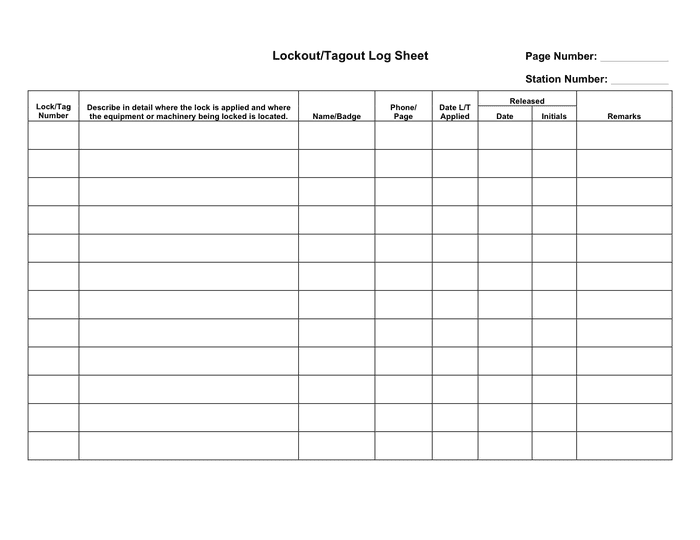
7. Attendee Sign-Off Mandatory for compliance. Collect names, roles, and signatures (or initials).
Without these components, your talk becomes a monologue — not a dialogue.
10 High-Impact Toolbox Talk Topics to Use Now
Not all topics are equally urgent. Focus on high-frequency, high-consequence risks. Here are 10 proven subjects that belong in any rotating schedule:
1. Working at Heights Discuss fall protection, harness inspection, and anchor points. Especially critical in roofing, scaffolding, and tower work.

2. Hand Tool Safety Cover proper use, storage, and inspection of wrenches, hammers, and cutters. A frayed wire cutter caused a shock incident at a Texas substation in 2023 — it started with a missed visual check.
3. PPE Compliance Go beyond “wear your gear.” Talk about why — UV exposure, hearing damage, chemical splashes — and how improper use nullifies protection.
4. Hazard Reporting Train teams to identify and report near-misses. Example: “If you see a tripping hazard, do you clean it, flag it, or just step over it?”
5. Lifting Techniques Even office staff move boxes. Demonstrate neutral spine, leg drive, and load planning. Include team lifts for heavy objects.
6. Slip, Trip, and Fall Prevention Focus on housekeeping: spilled oil, trailing cords, poor lighting. One refinery reduced incidents by 40% just by adding 5S checklists to daily talks.
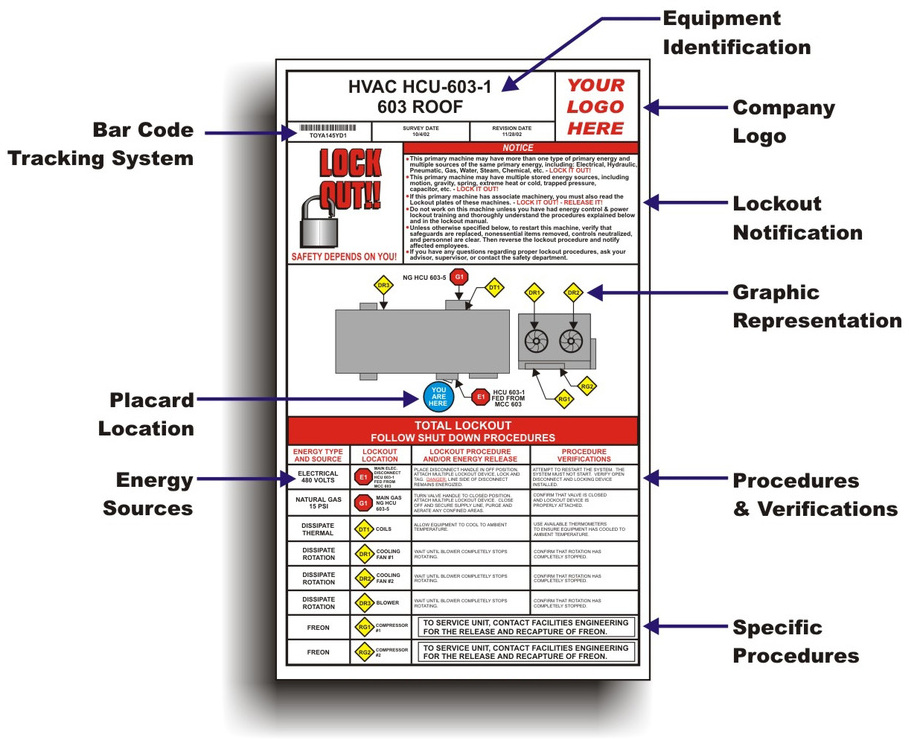
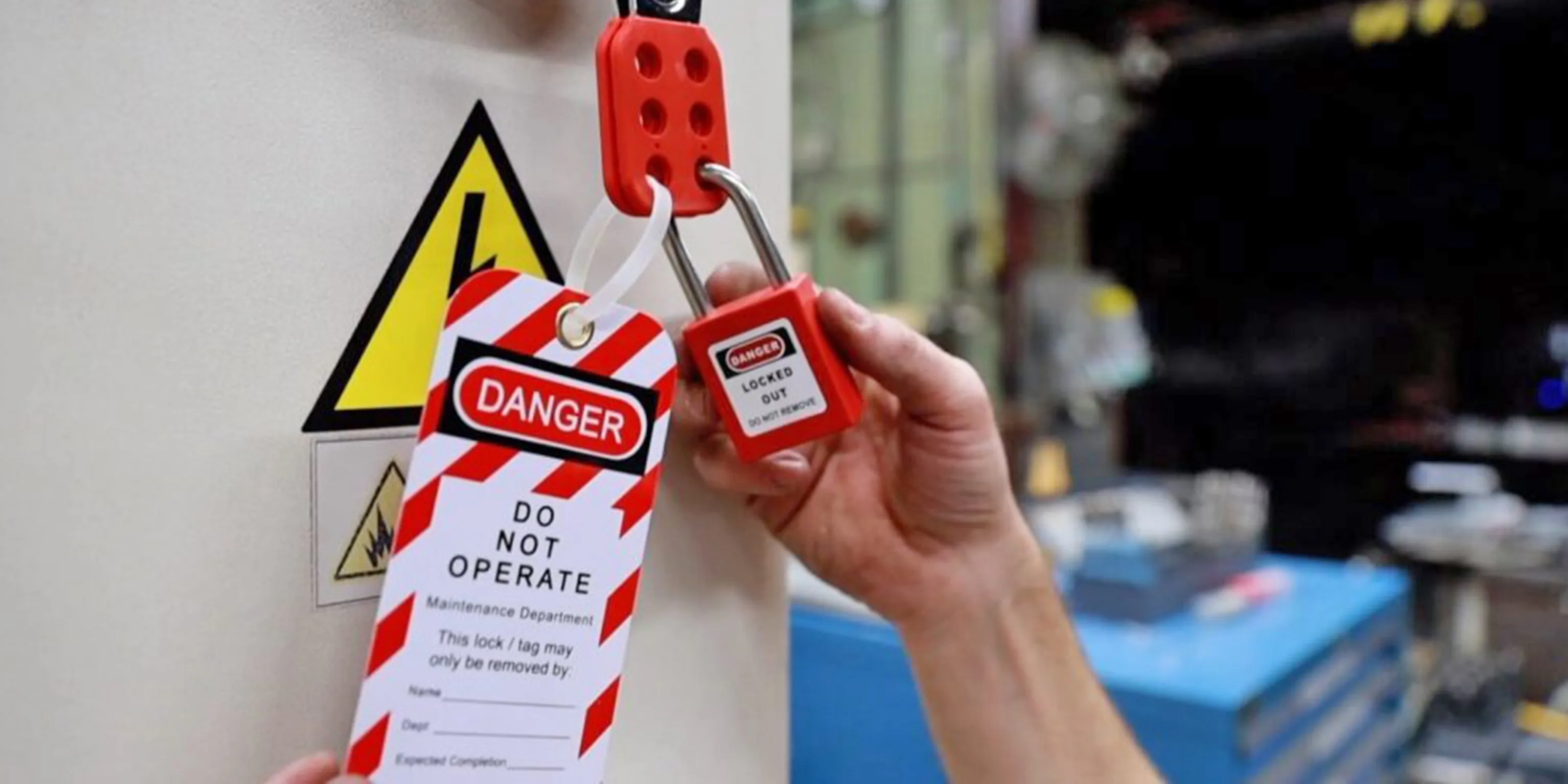
7. Electrical Safety Lockout/tagout (LOTO), voltage testing, and overhead line awareness. Essential for maintenance crews.
8. Hot Work Permits Review fire watch roles, flammable material storage, and emergency response. A welder in Ohio prevented a fire by catching a nearby propane tank during a pre-work check.
9. Chemical Handling Cover SDS access, labeling, PPE, and spill response. Use real products from your site.
10. Fatigue and Mental Awareness Often overlooked. Discuss shift length, hydration, and signs of mental fatigue. A drowsy operator in mining nearly backed into a blind spot — caught by a spotter.
Rotate these monthly. Revisit after incidents or near-misses.
How to Customize a Template for Your Industry
A generic template fails when it doesn’t reflect actual work. Here’s how to tailor it:
Construction
- Emphasize fall protection, crane signals, and excavation.
- Add photos of your current site layout.
- Include supervisor-led walkarounds post-talk.
Manufacturing
- Focus on machine guarding, lockout/tagout, and forklift zones.
- Use diagrams of production lines.
- Involve machine operators in drafting topics.
Utilities
- Cover arc flash risks, confined spaces, and de-energization.
- Reference NESC and NFPA 70E standards.
- Use recent audit findings as discussion starters.
Logistics/Warehousing
- Prioritize forklift safety, aisle obstructions, and loading dock procedures.
- Include seasonal hazards — icy docks in winter, heat stress in summer.
Customization isn’t about rewriting the template. It’s about localizing the content — using site-specific risks, roles, and language.
Common Mistakes That Undermine Toolbox Talks
Even with a great template, poor delivery kills effectiveness. Avoid these pitfalls:
❌ Reading Straight from the Page
This turns engagement into endurance. Use the template as a guide — not a script.
❌ Ignoring Worker Input If no one speaks, the talk failed. Ask open-ended questions. Reward honest answers.
❌ Talking About Irrelevant Hazards Discussing trenching safety on a day with no excavation? Workers tune out. Match topics to current tasks.
❌ Skipping Documentation No sign-in sheet = no proof. Auditors and insurers require records.
❌ Holding Talks Off-Site Conduct discussions where the work happens. Standing near the scaffolding makes it real.
Fix these by training facilitators — not just safety officers, but lead workers and supervisors — in active facilitation techniques.
Digital vs. Paper Templates: What’s Better? Many teams still use paper sign-in sheets and printed talking points. Others use apps and tablets. Both work — but each has trade-offs.
| Feature | Paper Template | Digital Template |
|---|---|---|
| Setup Cost | Low | Moderate to high |
| Accessibility | Site-only | Cloud-based, remote access |
| Record Keeping | Manual filing | Auto-saved, searchable |
| Engagement Tools | None | Photos, videos, quizzes |
| Compliance Proof | Physical archive | Timestamped, encrypted logs |
For small crews, paper works. For multi-site operations, digital platforms like SafetyCulture (iAuditor) or Procore streamline reporting and trend analysis.
But tech doesn’t replace quality content. A flashy app with weak topics is still ineffective.
Sample Toolbox Talk Topics Template (Ready to Use)
Topic: Proper PPE for Grinding Operations Date: April 5, 2024 Facilitator: J. Martinez, Lead Welder
Objective: Ensure all team members wear and inspect required PPE before starting grinding tasks.
Hazard: Metal shards, UV exposure, and hearing damage from angle grinders.
Best Practices: - Wear face shield + safety goggles (not one or the other) - Use hearing protection rated at least NRR 25 - Inspect gloves for tears before use - Confirm fire extinguisher is nearby
Real Example: At Facility X, a technician skipped goggles, relying only on a face shield. A small fragment entered his eye — surgery required.
- Discussion Questions:
- What PPE do you check first before starting a grinder?
- Have you ever seen someone skip PPE for “just a quick cut”?
- Where is the nearest fire extinguisher to the grinding station?
| Attendees: | ||
|---|---|---|
| ------ | ------ | ----------- |
| A. Reed | Welder | [ ] |
| T. Lowe | Apprentice | [ ] |
| M. Cruz | Operator | [ ] |
Use this structure across all topics. Save as a master file and duplicate for each session.
Make It Stick: 3 Workflow Tips for Daily Use
- Schedule in Advance
- Publish a monthly calendar of topics. Share it with crew leads so they can prepare.
- Assign Rotating Facilitators
- Let experienced workers lead talks. Peer-to-peer delivery increases credibility.
- Link to Work Orders
- Attach the day’s talk to the shift’s task list. Example: Excavation work? Lead with “Underground Utility Awareness.”
These habits embed safety into operations — not as an add-on, but as part of the workflow.
Final Step: Turn Templates Into Action
A toolbox talk topics template is only as good as its execution. Start with a solid framework, customize it for your site, train your team to lead with confidence, and review talks monthly for gaps.
Don’t wait for an incident to refine your approach. Use the template not just to talk about safety — but to practice it, every single day.
FAQ
What should a toolbox talk include? A clear topic, hazard explanation, best practices, real example, discussion questions, and attendee sign-off.
How long should a toolbox talk last? 5 to 15 minutes — focused and relevant to current work.
Who should lead a toolbox talk? Supervisors, safety officers, or trained crew leads. Rotate to build ownership.
How often should toolbox talks be held? At least weekly, or daily on high-risk sites. Always before new tasks or hazard changes.
Can toolbox talks be done digitally? Yes — via tablets or apps. Ensure signatures and records are securely stored.
Are toolbox talks a legal requirement? Not always, but OSHA and other regulators expect documented safety communication. They’re critical for compliance.
How do you keep toolbox talks engaging? Use real stories, ask open questions, hold them on-site, and encourage team input.
FAQ
What should you look for in Toolbox Talk Topics Template: Practical Guides for Safety Teams? Focus on relevance, practical value, and how well the solution matches real user intent.
Is Toolbox Talk Topics Template: Practical Guides for Safety Teams suitable for beginners? That depends on the workflow, but a clear step-by-step approach usually makes it easier to start.
How do you compare options around Toolbox Talk Topics Template: Practical Guides for Safety Teams? Compare features, trust signals, limitations, pricing, and ease of implementation.
What mistakes should you avoid? Avoid generic choices, weak validation, and decisions based only on marketing claims.
What is the next best step? Shortlist the most relevant options, validate them quickly, and refine from real-world results.