Every year, hundreds of workers suffer serious injuries—or worse—because machinery was accidentally energized during maintenance. The solution? Lockout tagout safety procedures. These standardized protocols are not just bureaucratic checkboxes; they’re lifelines that prevent electrocution, crushing, amputation, and other catastrophic events.
Despite widespread awareness, violations of lockout tagout (LOTO) regulations remain among OSHA’s most frequently cited offenses. Why? Because many organizations treat LOTO as a paperwork exercise rather than a core safety discipline.
This guide cuts through the noise. It delivers a practical, field-tested breakdown of lockout tagout safety procedures—how they work, where they fail, and how to implement them so they actually protect people.
What Is Lockout Tagout (LOTO)?
Lockout tagout refers to the systematic process of de-energizing equipment and securing it against unexpected startup during servicing or maintenance. It's a dual-method approach:
- Lockout involves physically isolating energy sources using keyed locks.
- Tagout means placing warning tags on equipment to signal that it is not to be operated.
While tagout alone can be used in certain cases, OSHA strongly prefers lockout because it provides a physical barrier—not just a visual reminder.
LOTO applies across industries: manufacturing, utilities, construction, healthcare (for medical equipment), and anywhere hazardous energy exists. Types of energy include electrical, mechanical, hydraulic, pneumatic, chemical, thermal, and gravitational.
Real-World Example
A maintenance technician needs to clear a jam in a conveyor belt system. Without LOTO, someone could remotely restart the conveyor, pulling the worker into moving parts. With proper LOTO, the power source is disconnected, locked, and tagged—making accidental activation impossible.
Why Lockout Tagout Procedures Matter
The stakes are high. According to OSHA, compliance with LOTO standards prevents an estimated 120 fatalities and 50,000 injuries annually in the U.S. alone.
Failure isn't just dangerous—it’s costly.
- Average OSHA LOTO violation fines exceed $15,000 per incident.
- Severe cases can lead to criminal charges under the General Duty Clause.
- Downtime from accidents disrupts operations far more than scheduled maintenance ever could.
But beyond the legal and financial risks, LOTO protects organizational trust. Workers who see safety taken seriously are more engaged, more productive, and less likely to leave.
Common Misconceptions
- "We’ve never had an accident, so we don’t need strict LOTO."
- Complacency kills. Near-misses often go unreported until tragedy strikes.
- "Tagout is enough."
- Tags can be ignored or removed. Locks enforce compliance.
- "LOTO slows us down."
- A five-minute LOTO process is faster than a six-month investigation after an injury.
Key Elements of an Effective LOTO Program
A compliant LOTO program isn’t just about locks and tags. It’s a full ecosystem of policies, training, and verification.
1. Energy Control Procedures (ECPs)
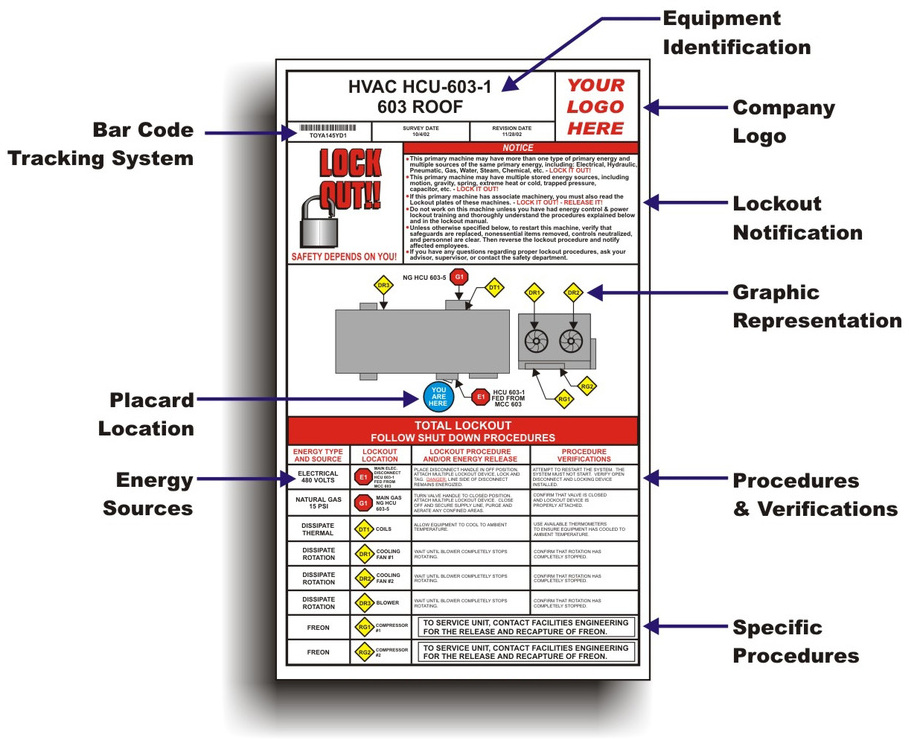
Every machine or process requiring maintenance must have a documented ECP. These step-by-step instructions specify:
- All energy sources (electrical panels, hydraulic lines, etc.)
- Methods for isolation (circuit breakers, valve closures)
- Locations of lock points
- Sequence for shutdown, isolation, and re-energization
Tip: Use visual diagrams. A photo-based checklist mounted near equipment reduces errors.
2. Authorized vs. Affected Employees
OSHA distinguishes between two roles:
| Role | Responsibility |
|---|---|
| Authorized Employee | Implements LOTO, performs maintenance, applies locks |
| Affected Employee | Operates or uses equipment but does not perform servicing |
Only authorized employees may apply or remove locks. Both groups must receive annual training.
3. Lockout Devices and Tags
Use only standardized, durable equipment:
- Lockout hasps and valve locks ensure one lock per person.
- Group lockout boxes allow multiple workers to lock out a single source.
- Tags must include:
- Name of the authorized employee
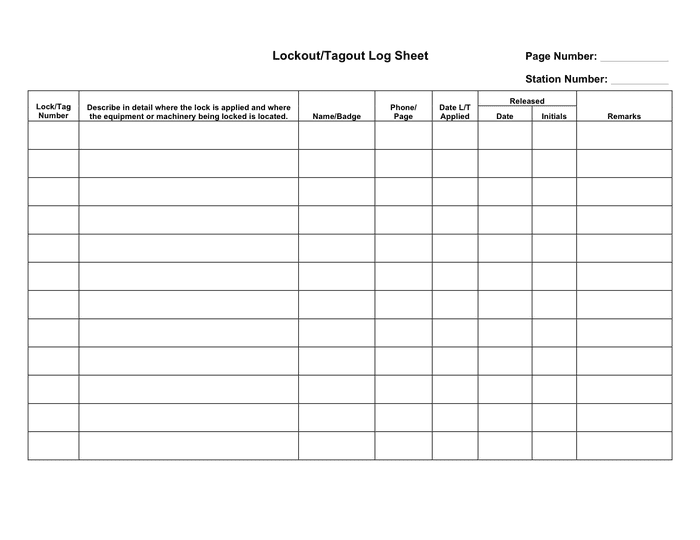
- Date and time applied
- Reason for lockout
Never reuse tags. They are temporary warnings, not permanent labels.
Step-by-Step Lockout Tagout Process
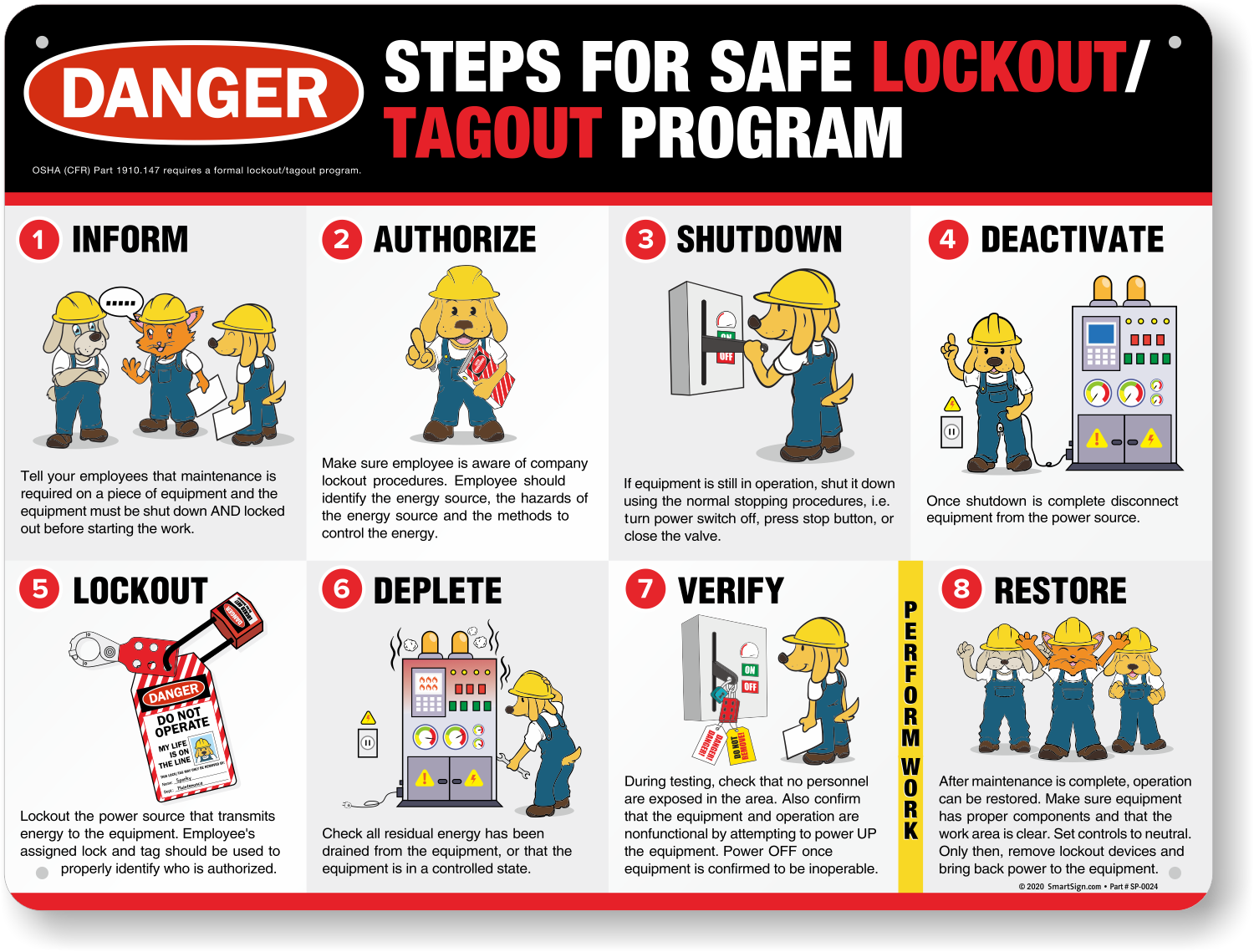
Following a consistent sequence is non-negotiable. Deviations create risk. Here’s the OSHA-aligned seven-step process:
Step 1: Prepare for Shutdown
Identify all energy sources and review the ECP. Gather necessary tools and lockout devices.
Mistake Alert: Skipping preparation leads to incomplete isolation. One missed hydraulic line can cause catastrophic failure.
Step 2: Notify Affected Personnel
Inform all operators and nearby workers that maintenance is about to begin.
Step 3: Shut Down Equipment
Use normal stopping procedures—never rely on emergency stops as the primary shutdown method.
Step 4: Isolate Energy Sources
Turn off breakers, close valves, block moving parts. This is where physical disconnection happens.
Pro Tip: Double-isolate high-risk systems. For example, disconnect power and relieve pressure in hydraulic lines.
Step 5: Apply Locks and Tags
Each authorized worker applies their personal lock and tag. Never share keys. Use lockout hasps to allow multiple locks on one point.
Step 6: Release Stored Energy
This is often overlooked. Residual energy in springs, capacitors, or elevated components can activate machinery.
Examples: - Bleed air from pneumatic lines - Lower suspended loads - Drain capacitors
Verify zero energy state using test instruments (e.g., voltage testers).
Step 7: Verify Isolation
Attempt to start the equipment using normal controls. It should not operate. Then return controls to “off” position.
Real Use Case: A technician at a food processing plant skipped verification. A co-worker unknowingly reopened a valve. The mixer engaged, destroying tools inside—and nearly injuring the technician.
Common LOTO Failures and How to Fix Them
Even experienced teams make mistakes. Here are recurring issues and their solutions:
Failure 1: Incomplete Energy Source Identification
Problem: Teams isolate electrical power but forget pneumatic or gravity-based hazards.
Fix: Conduct energy audits. Map all inputs and stored energy types per machine.
Failure 2: Group Lockout Without Coordination
Problem: Multiple workers lock out, but the last person removes all locks before everyone is clear.
Fix: Use a group lockout box. Each worker places their lock on the box. The machine stays locked until all locks are removed.
Failure 3: Using Personal Locks for Others
Problem: A supervisor removes a worker’s lock because “they’re late.”
Fix: Enforce the “one person, one lock, one key” rule. Develop a formal lock removal procedure for emergencies—only after verifying the worker is safe.
Failure 4: Skipping Retraining
Problem: New equipment introduced, but training not updated.
Fix: Re-evaluate ECPs and retrain whenever processes change. Document all sessions.
Industry-Specific LOTO Challenges
LOTO isn’t one-size-fits-all. Context changes everything.
Manufacturing
High machinery density means complex interlocks and shared power sources. Best Practice: Color-code locks by department. Use shadow boards to track issued lockout kits.
Healthcare
MRI machines, sterilizers, and surgical robots involve high-energy systems. Challenge: Emergency access vs. safety. Solution: Designate rapid-response LOTO teams trained in urgent scenarios.
Construction
Mobile equipment (excavators, lifts) and temporary power setups increase risk. Tip: Treat each job site as a unique LOTO environment. Require lockout checks in pre-shift inspections.
Auditing and Continuous Improvement
A static LOTO program decays. Audit at least annually—or after any incident.
Checklist for Internal Audits:
- Are ECPs up to date and accessible?
- Are locks and tags in good condition?
- Do employees demonstrate correct procedure execution?
- Are contractors required to follow site-specific LOTO?
Use findings to refine training and update procedures. Track metrics: % of completed audits, number of observed deviations, retraining rates.
Insight: Companies with quarterly LOTO drills report 60% fewer near-misses than those auditing annually.
Tools and Equipment for Reliable LOTO
The right gear supports compliance. Here are five essential tools:
| Tool | Purpose | Best For |
|---|---|---|
| Personal Lockout Locks | Individual control with employee-specific keys | Every authorized worker |
| Valve Lockouts | Prevents accidental opening of fluid/gas lines | Piping systems, chemical plants |
| Circuit Breaker Locks | Secures electrical disconnects | Electrical panels, machinery |
| Group Lockout Station | Central hub for multi-person lockouts | Team maintenance tasks |
| Lockout Hasps | Allows multiple locks on one isolation point | Shared energy sources |
Invest in durable, standardized equipment. Cheap locks that break under pressure defeat the purpose.
Closing: Make LOTO a Culture, Not a Checklist
Lockout tagout safety procedures work—when they’re taken seriously. The most advanced locks won’t protect anyone if the mindset is “just get it done.”
Start with leadership. Supervisors must model LOTO compliance every time. Reinforce it with clear accountability, regular training, and recognition for safe behavior.
Update your energy control procedures now. Walk through one high-risk machine with your maintenance team. Are all energy sources identified? Are locks applied correctly? Is verification happening?
Do this today, and you’re not just avoiding OSHA citations—you’re protecting lives.
FAQ
What should you look for in Lockout Tagout Safety Procedures: A Complete Guide to Compliance? Focus on relevance, practical value, and how well the solution matches real user intent.
Is Lockout Tagout Safety Procedures: A Complete Guide to Compliance suitable for beginners? That depends on the workflow, but a clear step-by-step approach usually makes it easier to start.
How do you compare options around Lockout Tagout Safety Procedures: A Complete Guide to Compliance? Compare features, trust signals, limitations, pricing, and ease of implementation.
What mistakes should you avoid? Avoid generic choices, weak validation, and decisions based only on marketing claims.
What is the next best step? Shortlist the most relevant options, validate them quickly, and refine from real-world results.